“Concentrating on common everyday activities, create a video (120-300 seconds in duration) that primarily uses sequencing, pacing, editing and shot rather than dialogue, action, or music to construct a narrative that gives the activities poetic, visual and/or metaphoric impact to communicate something that is not directly expressed. Consider the idea of a pregnant pause which is a meaningful lull in a conversation, or a delay in speech used to give time to consider the consequences of a statement. In this project focus on the kinds of common, generally unnoticed activities that exist between the “big” memorable events of our lives. Also, I am asking you to primarily rely on editing your video to create meaning (as opposed to dialogue or plot). Editing creates a “third meaning” that exists in the spaces between shots. You may choose to have audio or not but NO MUSIC OR DIALOG so you can use ambient (actual sound).”
Fieldwork 1: brainstorm an everyday activity (ex. Washing a car, tying a shoe)
Outline each activity into between 3 to 7 steps.
Create a card for each step of the activity and the occurrence on 3”x5” cards. At this point you need only use words to describe the step (ex. “scoop grounds from coffee can”).
Shuffle the cards randomly to find new ways of ordering the events in sequence.
Each student should now create a storyboard based off of one or two of these new shuffled sequences to serve as the basis for their video project.
Fieldwork 2: You now are ready to storyboard your sequence. Translate each card in your sequence into a storyboard panel. This is a sketch that indicates point of view and scope. It should also include notes about imagery, style, camera movement, subject movement, transition (typically only exit transitions) and structural juxtapositions.
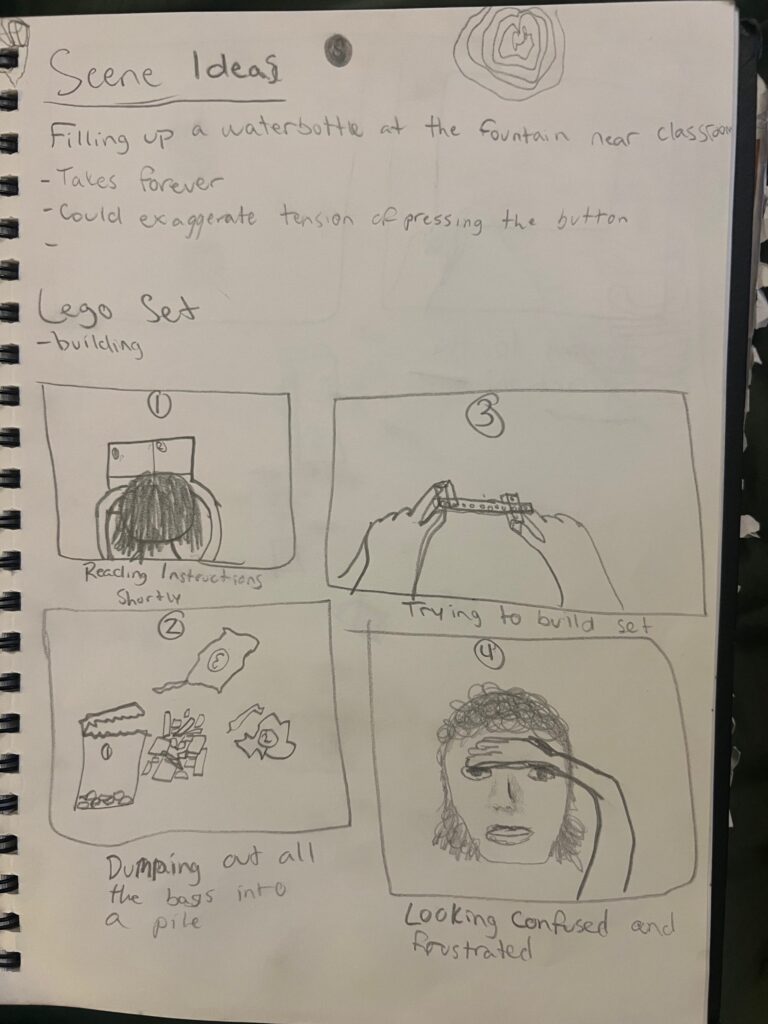
Planning and Storyboard
For my video project I thought of a few everyday activities that could work for a film but settled on an idea that me and Preston came up with together. We both wanted to make a film about building a Lego set and thought it would be an interesting way to go about the project. We could make different storyboards for the same task and see how our videos differ.
When making my storyboard, I thought it would be interesting to make the Lego set messed up and not follow the instructions. I imagined this could add tension to the scenes when I don’t follow the instructions, and there could be a lot of opportunities for pauses. The main pregnant pause that I wanted to have was at one point to walk away from the Lego set I was attempting to build and be discovered staring at nothing.
Defining Pregnant Pause
A pregnant pause in film is a deliberate and prolonged moment of silence or hesitation, often marked by meaningful facial expressions, body language, or a tense atmosphere. It builds anticipation and draws the audience’s attention to an unspoken emotion, decision, or revelation. It is effective because it creates tension and emotion. Silence invites viewers to engage and feel the weight of a moment. It creates unspoken storytelling that lets the audience analyze a meaning without dialogue to be a guide. A pregnant pause breaks rhythm, emphasizing what comes before and after, making the scene’s climax more impactful.
In my video I could have had a few interpretations of pauses. The main pause I was hoping for the audience to get was when I walked out of the room and stared at the light. I gave no explanation for the purpose of this and left it for the viewer to decide the meaning. My idea for the pause was that my character was getting frustrated trying to build a Lego set with no instructions, so he decided to just walk away from the table and go disassociate. Whether this was clear or not does not necessarily matter because either way I think it added a unique and funny element to the video.